
Plastic materials we work with
We cut, machine and thermoform acrylic and other engineering plastics. Here is each material with its thicknesses, formats, properties and uses, so you can choose the right one for your part.
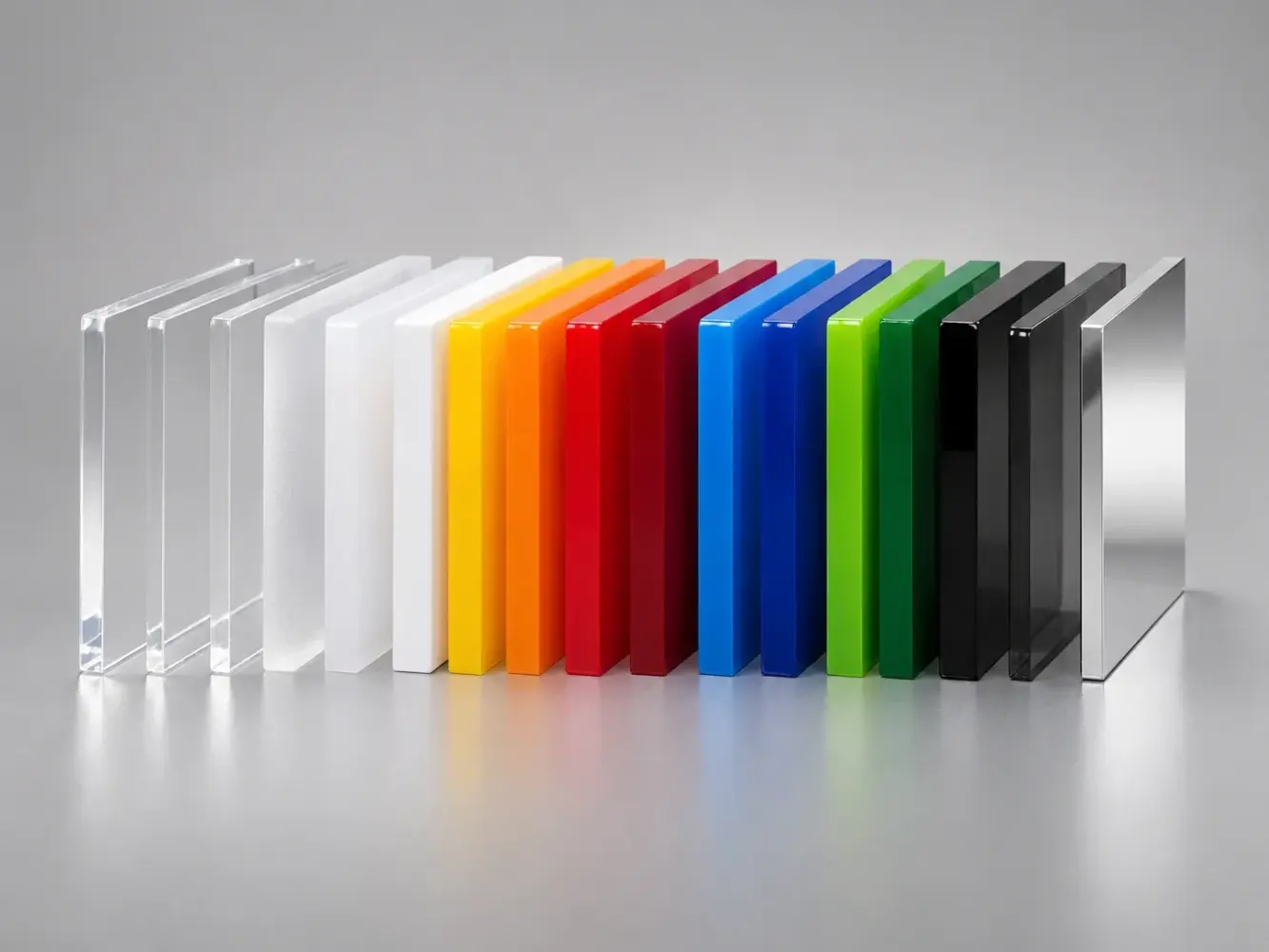
Engineering plastics for cutting, machining and thermoforming
At Apligam we work with acrylic (Plexiglas®, Altuglas® and Irpen®), solid and multiwall polycarbonate, PE 500 and PE 1000 polyethylene, foamed and rigid PVC, composite panels such as Dibond® and two-layer ABS, as well as tubes and rods. These are the engineering plastics we cut and machine every day in our workshop in Seville.
Each plastic is chosen for what the part has to withstand: transparency, impact, weather, wear or contact with food. If you are not sure, tell us what the part is for and we will recommend a material in the quote.
Quick comparison of materials
This table sums up what sets each plastic apart, based on our own data and the manufacturers’ data sheets.
| Material | Appearance | Impact resistance | Temperature | Outdoor use | Food contact | Usual thicknesses |
|---|---|---|---|---|---|---|
| Acrylic (PMMA) | Transparent (93%) or coloured | 10 to 20 times that of glass | Can be formed from 80 ºC | Yes: UV-resistant, does not yellow | — | 2 to 100 mm (clear) |
| Solid polycarbonate | Transparent | Extremely high | Up to 130 ºC | Yes, with UV protection | — | 2 to 10 mm |
| Multiwall polycarbonate | Translucent, with air chambers | High | — | Yes, with optional UV protection | Not applicable | 4 to 16 mm |
| Polyethylene PE 500 / PE 1000 | Opaque | Good; very good abrasion resistance | — | — | Yes, suitable | (sheets and rods) |
| Foamed and rigid PVC | Opaque white | — | — | Yes (outdoor signage) | — | — |
| Dibond® (composite) | Lacquered or brushed aluminium | Good mechanical properties | — | Yes: resists corrosion and weather | Not applicable | 3 and 4 mm |
| Two-layer ABS (Gravoply) | Two colours; matt, satin, brushed or gloss | — | — | Yes: UV-stable | Not applicable | 0.8 to 1.3 mm |
| Material | Cut to size | Laser cutting | CNC machining | Thermoforming / bending |
|---|---|---|---|---|
| Acrylic | Yes | Yes, up to 15 mm, polished edge | Yes | Yes (extruded works better) |
| Solid polycarbonate | Yes | — | Yes | On a folding machine; cold bending |
| Multiwall polycarbonate | Yes | — | — | — |
| Polyethylene | Sheets and rods machined to size | — | Yes | — |
| Foamed and rigid PVC | Yes | — | Yes | — |
| Dibond® | Yes | — | Yes | Can be curved |
| Two-layer ABS | Yes | Yes, cutting and engraving | Yes, engraved with a cutter | Not applicable |
Acrylic (PMMA)
Acrylic, also known as PMMA or by the trade names Plexiglas® and Perspex®, is the most transparent plastic (93%) and is ten to twenty times more impact-resistant than glass at half the weight. We work with Plexiglas®, Altuglas® and Irpen®, cast and extruded, from 2 to 100 mm in clear.
Colours and thicknesses
| Colour | Available thicknesses |
|---|---|
| Clear | 2, 3, 4, 5, 6, 8, 10, 15, 20, 25, 30, 40, 50, 60, 80 and 100 mm |
| Opaque white | 3, 4 and 5 mm |
| Opal white / frost white | 3, 4, 5, 6, 8 and 10 mm |
| Opaque black | 3, 4, 5, 6, 8, 10 and 15 mm |
| Opaque and transparent colours | 3 mm |
| Transparent smoke grey / bronze | 3, 4, 6 and 8 mm |
Usual colours: clear, opaque white, opal white, opaque black, smoke grey, bronze, orange, yellow, red, blue and green. Other colours on request. Full sheet size: 3050 × 2050 mm; we only cut and charge for the piece you need.
Properties
- 93% light transmission.
- Ten to twenty times the impact resistance of glass, at roughly half the weight for the same thickness.
- Resists weather and UV light and does not yellow.
- Good thermal and acoustic insulation.
- Surface hardness similar to aluminium: metal objects can scratch it, but the finish can be restored by polishing.
- It can be machined, sanded, cut, polished and thermoformed with heat from 80 ºC.
- It is attacked by acetone, alcohol, ethyl acetate, acetic acid and sulphuric acid.
Uses: signs, displays, acrylic signage, 3D letters, awards, display cases and ballot boxes; in industry, watertight containers, domes, screens, boat windows, housings, laboratory equipment and light fittings; in the food trade, sweet dispensers, patisserie display cases and ice-cream parlour displays (see acrylic for hospitality and food).
Cast or extruded
Cast acrylic gives a better result when laser-engraved; extruded acrylic responds better to thermoforming. For cutting, they behave the same. The full comparison is in cast vs extruded acrylic.
Do you just need a clear sheet cut to size? You can buy it online from Crilato, our online shop (in Spanish), with instant pricing.
Solid polycarbonate
Solid polycarbonate is a transparent thermoplastic with extremely high impact resistance that withstands heat up to 130 ºC. We work with Makrolon® and Lexan® in clear, from 2 to 10 mm (2, 3, 4, 5, 6, 8 and 10 mm).
- High strength and stiffness, and high dimensional stability.
- Good electrical insulator.
- Weather-resistant, with optional UV protection.
- Flexible enough to be cold-bent; in the workshop we fold it on a folding machine.
Uses: domes, polycarbonate machine guards, boat windows, safety glazing, housings and any part that has to withstand impact.
Multiwall polycarbonate
Multiwall polycarbonate comes in sheets with internal air chambers, which make it translucent, strong and very light. We work with Plexiglas® multiwall sheet and cut it to the size of each opening, mainly for roofing and outdoor enclosures.
| Type | Sheet size | Thicknesses |
|---|---|---|
| Clear | 6000 × 2100 mm | 4, 6, 8, 10 and 16 mm |
| Clear | 4000 × 2100 mm | 10 and 16 mm |
| Clear | 3000 × 2100 and 3000 × 1250 mm | On request |
| Opal white / frost | 6000 × 2100 mm | 6, 8, 10 and 16 mm |
| Frost white | 6000 × 1250 and 3000 × 1250 mm | 6 mm |
Other sizes on request. It resists the weather (with optional UV protection), diffuses light well, insulates against heat and is easy to handle.
Uses: enclosures, roofing for courtyards, industrial units, sports and agricultural buildings, canopies, balconies, pergolas and greenhouses.
Polyethylene PE 500 and PE 1000
PE 500 and PE 1000 polyethylene is an opaque, high-molecular-weight plastic that is suitable for food use. We work with it in sheets and rods and machine it to size for parts exposed to friction and wear.
- Good impact resistance and very good abrasion behaviour.
- Very low coefficient of friction.
- Very good chemical resistance and very low moisture absorption.
Uses: food cutting boards and tables, guides, wheels, profiles, die-cutting plates and parts for food-processing and production machinery. We make them with CNC machining of plastics; see examples in machined plastic parts.
Foamed and rigid PVC
Foamed and rigid PVC is an opaque white material that is light, strong and easy to work, and can be painted, printed and machined. We work with Forex® and cut and machine it to size.
Uses: indoor and outdoor signage and posters, window dressing, exhibition stands, wayfinding, decoration, display panels, protective boxes, enclosures and air-conditioning ducts. It takes direct UV printing, as in the printed foamed-PVC terrace-table protector we made for Hermanos Moreno.
Dibond® and composite panels
Dibond® is two aluminium sheets bonded to a polyethylene core: a very flat, light panel that resists corrosion and weather. We work with Dibond®, Alucobond® and Lyxbond®, also in brushed silver and gold finishes, in 3 and 4 mm.
| Sheet sizes | Thicknesses |
|---|---|
| 3050 × 1500 mm · 4050 × 1500 mm · 3050 × 2050 mm | 3 and 4 mm |
- High thermal and acoustic insulation and good mechanical properties.
- Very flat, easy to curve and quick to install.
Uses: façades, signs and panels with corporate branding, wall and ceiling decoration for commercial premises and, in industry, bodywork for refrigerated vehicles. We cut and machine it to size.
Two-layer ABS (Gravoply)
Two-layer ABS is a thin acrylic-based sheet with a 0.05 mm top microlayer: when it is engraved, by laser or with a cutter, the colour underneath shows through in very fine lines. It is the material used for identification plates and technical labels.
| Detail | Value |
|---|---|
| Thickness | 0.8 to 1.3 mm |
| Sheet sizes | 1220 × 610 mm and 610 × 610 mm |
| Finishes | Matt, satin, brushed and gloss |
| Colours | Opaque colours, silver and gold |
| Engraving depth | 0.1 mm |
- UV-stable: suitable for indoor and outdoor use.
- Clean cut that does not burn the material; it can be drilled, bevelled and cut to special shapes.
- Consistent thickness, colour and flatness from sheet to sheet, which is essential for engraving in series.
- Thin and flexible: it can be used to label curved surfaces.
Uses: identification plates, professional nameplates, indoor and outdoor signage, technical labels and machine front panels. The metallic finishes replace metal indoors. We engrave it as part of our acrylic laser cutting and laser engraving service.
Acrylic and polycarbonate tubes and rods
We work with clear, high-gloss tubes and rods in 2000 mm lengths, and cut and finish them to size for furniture, lighting and shops.
| Product | Diameters |
|---|---|
| Acrylic rods | 3 to 50 mm |
| Acrylic tubes | 6 to 400 mm outside diameter |
| Polycarbonate tubes | 10 to 250 mm outside diameter |
We finish turned parts with plastic turning.
Other materials
Besides the above, we machine polypropylene (for example, parts for slotting rods into) and wood and wood-based boards for joinery and interior design projects, and we turn rigid PVC. If your part needs a different plastic, ask us.
How to choose the material for your part
To choose the material, start with the main demand on the part: transparency, impact, weather, wear or food. That rules out most options, and then we adjust thickness and finish.
| If your part needs… | Usual material |
|---|---|
| Maximum transparency and a good edge finish | Acrylic |
| To withstand heavy impact (forklifts, moving machinery) | Solid polycarbonate |
| To cover a large opening with light and little weight | Multiwall polycarbonate |
| Friction, wear or contact with food | Polyethylene PE 500 / PE 1000 |
| Lightweight signage, stands, panels for printing | Foamed PVC |
| A flat, rigid panel for a façade or outdoor sign | Dibond® |
| A plate or label engraved in two colours | Two-layer ABS |
For machined parts, the detailed comparison is in which plastic to choose for machining.
Questions about materials
What is the difference between solid and multiwall polycarbonate?
Solid polycarbonate is a solid, transparent sheet, from 2 to 10 mm, with very high impact resistance: it is used for machine guards and safety glazing. Multiwall polycarbonate has internal air chambers, is translucent and very light, from 4 to 16 mm, and is used for roofing, enclosures and greenhouses.
Which plastic can I use in contact with food?
The PE 500 and PE 1000 polyethylene we work with is suitable for food use; we use it for cutting boards, guides and parts for food-processing machinery. Acrylic is widely used for hospitality and patisserie displays; for direct contact, ask us which grade is suitable and under what conditions.
When is Dibond used instead of foamed PVC?
Dibond® is a panel made of two aluminium sheets with a polyethylene core: very flat and resistant to corrosion and weather, for façades, outdoor signs and corporate panels. Foamed PVC is lighter and easier to work, and is used mainly for signage, window dressing and stands.
Which material is best for engraved identification plates?
Two-layer ABS (Gravoply): a 0.8 to 1.3 mm sheet with a 0.05 mm top layer that reveals the colour underneath when engraved by laser or with a cutter. It is UV-stable and suitable for indoor and outdoor use. For wall plaques with more presence, acrylic is used.
Can you source a colour or thickness that is not in the tables?
The tables show what we work with regularly. Other acrylic colours and other multiwall polycarbonate sizes can be ordered on request: tell us the colour (ideally with a sample or a reference), the thickness and the quantity, and we will tell you whether it is possible.